Parkeer PM
Wilde je het in het Engels doen? Het onderwerp is wel zinderend actueel; we zitten er momenteel middenin.
- Vandaar. Ze spreken en verstaan in de Verweghistans niet allemaal Nederlands en dit thema maken we ‘op bestelling. Engels werd dus verzocht, bovendien is het leuk om te doen’
Oké, why not. Het is een boeiend onderwerp. De nomenklatoera’s hebben de mond vol van ‘institutioneel terrorisme ‘en institutioneel dit en dat, maar nooit hoor je ze over ‘institutionele corruptie.’
- Vandaar.
……………. …………… ……………..
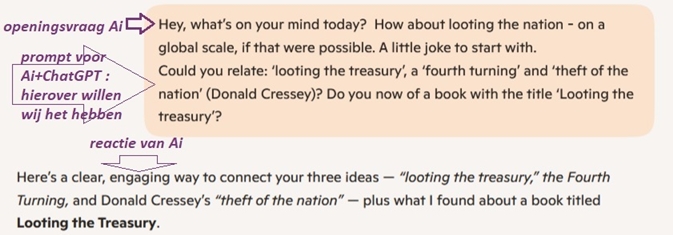
🧩 How these concepts relate
💰 Looting the treasury. This phrase is usually used metaphorically to describe:
– large‑scale extraction of public wealth
– often through legal‑looking mechanisms (bailouts, insider deals, regulatory capture)
– sometimes through outright corruption or elite self‑dealing
It’s not a technical term — it’s a political and sociological one — but it captures the idea of elites using state power to enrich themselves at the expense of the public.
🔥 The Fourth Turning (Strauss & Howe)
The “Fourth Turning” is the crisis phase in their cyclical theory of history. It’s characterized by:
– Institutional breakdown,
– Loss of public trust
– Concentration of power
– Major conflict or restructuring
In a Fourth Turning, societies often experience:
– Financial crises
– Legitimacy crises
– Elite overreach
So the idea of “looting the treasury” fits neatly into the symptoms of a Fourth Turning: when institutions are weak, elites often take advantage.
🕵️♂️ Donald Cressey’s “theft of the nation”
Cressey, a criminologist, used this phrase to describe:
– Systemic, organizational crime
– Crimes committed through institutions, not against them
– White‑collar crime that becomes normalized or embedded in governance
This is the perfect bridge between the other two concepts. If “looting the treasury” is the action, and the Fourth Turning is the historical moment, then Cressey’s “theft of the nation” is the mechanism — institutionalized wrongdoing carried out by those in positions of trust.
Put together, the three ideas describe a pattern:
In periods of institutional crisis (Fourth Turning), elites may exploit weakened systems to extract wealth (looting the treasury) through normalized organizational crime (theft of the nation).
📚 Is there a book titled Looting the Treasury?
I searched for it, and no book with that exact title appears in major catalogs. However, the closest match — and thematically very relevant — is: *********
It focuses on:
– How financial elites extracted massive wealth
– How the public ended up paying for the fallout
– How institutional failures enabled the process
It’s not about government insiders looting the treasury directly, but it’s absolutely in the same conceptual universe.
🧠 Want to go deeper?
If you’re exploring the intersection of: historical cycles, elite behavior, systemic corruption, financial crises
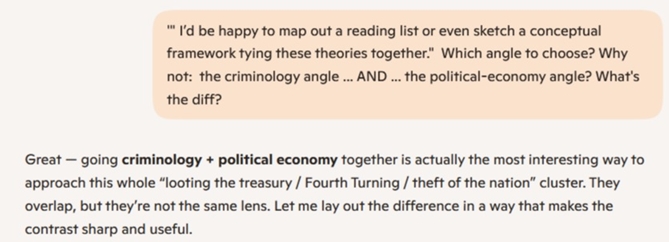
…there’s a fascinating intellectual thread connecting all of this. I’d be happy to map out a reading list or even sketch a conceptual framework tying these theories together.
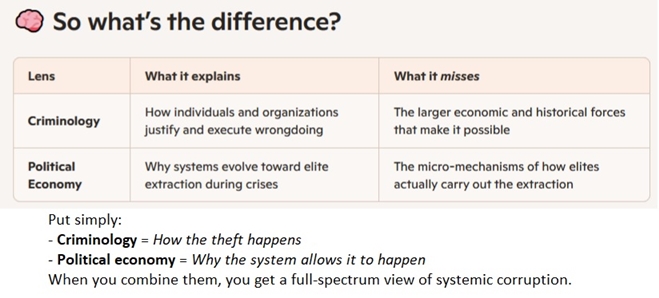
Where would you like to take the conversation next — the historical angle, the criminology angle, or the political‑economy angle?
…………………….. ………………………… ………………………..
…………………….. ………………………… ………………………..