PARKEER PM
*
🌆 Leavis and Sennett: A Shared Worry About Modernity
Both thinkers diagnose a loss of depth in modern life. But they focus on different domains:
– Leavis: culture, taste, and the erosion of intellectual and moral standards under mass culture.
– Sennett: work, identity, and the erosion of long-term character under flexible capitalism.
Despite this difference, their critiques overlap in powerful ways.
🎭 1. Mass Culture vs. Flexible Capitalism
Leavis:
– Argues that mass civilization produces standardized, shallow cultural forms.
– Believes that industrial modernity creates passive consumers rather than active, critically engaged individuals.
– Sees “minority culture” (the educated, discerning few) as the last defense against cultural flattening.
Sennett:
Shows how modern capitalism—short-term contracts, constant reinvention, instability—erodes people’s ability to form coherent life narratives.
Workers become flexible, adaptable, and fragmented, rather than grounded in stable identities or long-term commitments.
Connection: Both see modern systems as homogenizing forces that weaken individuality.
🧠 2. The Erosion of Character and the Erosion of Culture
Leavis:
Culture is sustained by disciplined attention, tradition, and moral seriousness. Mass culture undermines these by offering easy, formulaic entertainment.
Sennett:
Character is sustained by long-term commitments, stable work identities, and coherent life stories. Flexible capitalism undermines these by demanding constant reinvention.
Connection:
Leavis’s “minority culture” and Sennett’s “character” are structurally similar ideas:
– Both require continuity, discipline, and deep engagement.
– Both are threatened by modern systems that reward surface-level adaptability over depth.
🧩 3. Loss of Narrative
This is one of the most striking parallels.
Leavis:
Mass culture breaks the continuity of cultural tradition. People lose access to the “great tradition” that once shaped moral and imaginative life.
Sennett:
Flexible capitalism breaks the continuity of personal narrative. People cannot build a coherent sense of self when their work lives are fragmented.
Connection:
Both diagnose a breakdown of narrative continuity—cultural for Leavis, biographical for Sennett. In both cases, modernity produces fragmentation.
For Leavis, the threat is mass media.
For Sennett, it is economic structures. But both diagnose a world where people lose the ability to cultivate depth, continuity, and self-direction.


🧭 1. Is Sennett a “next phase” after Leavis?
Yes — and the comparison becomes quite powerful when framed historically.
Leavis (1930s): The age of mass culture
– Industrial modernity produces standardized cultural products.
– The threat is cultural homogenization.
– The individual becomes a passive consumer.
– The crisis is primarily aesthetic and moral.
Sennett (1990s): The age of flexible capitalism
– Post-industrial capitalism produces unstable, short-term work lives.
– The threat is psychological fragmentation.
– The individual becomes a flexible, self-reinventing worker.
– The crisis is primarily biographical and existential.
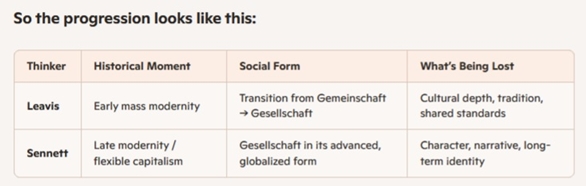
The progression
Leavis diagnoses the early effects of mass society on culture. Sennett diagnoses the later effects of global capitalism on character.
You could say:
Leavis describes the cultural consequences of early modernity; Sennett describes the personal consequences of late modernity.
Leavis worries about the loss of cultural standards. Sennett worries about the loss of personal coherence.
Both are describing modernity’s deepening impact on the human condition, but Sennett’s world is more advanced, more fragmented, and more economically driven.
🧪 2. Why “erosion” and “corrosion”?
These metaphors are not accidental. They’re doing conceptual work.
🌊 Erosion (Leavis)
Erosion suggests a gradual wearing away of something once solid.
In Leavis’s case:
– The “great tradition” of culture is slowly worn down.
– Standards, taste, and critical judgment are weakened.
– Mass culture acts like a tide that smooths everything into sameness.
Erosion is slow, naturalized, almost geological. It fits Leavis’s sense that mass culture is a steady, creeping force.
🧷 Corrosion (Sennett)
Corrosion is more chemical, internal, and destructive.
In Sennett’s case:
– Character is not just worn down — it is eaten away from within.
– The demands of flexible capitalism dissolve the inner structures of selfhood.
– Corrosion implies a reaction: the system actively destabilizes identity.
Corrosion is active, invasive, and damaging. It fits Sennett’s sense that modern capitalism doesn’t just weaken character — it dissolves it.
🔗 3. How the metaphors relate to each other
You can build a compelling argument that:
– Erosion (Leavis) describes the early, surface-level effects of mass modernity.
– Corrosion (Sennett) describes the later, deeper, more intimate effects on the self. Erosion affects culture. Corrosion affects character.
Erosion happens on the outside (public culture). Corrosion happens on the inside (personal identity).
This is why Sennett feels like a next phase: modernity has moved from shaping what we consume to shaping who we are.
Here’s a tight, academically useful formulation:
Sennett can be read as extending Leavis’s critique of modernity into a later historical moment. Where Leavis describes the erosion of cultural depth under mass civilization, Sennett shows how late capitalism corrodes the very structure of personal character. The shift from “erosion” to “corrosion” marks a deepening of modernity’s impact — from the weakening of cultural standards to the dissolution of individual identity.
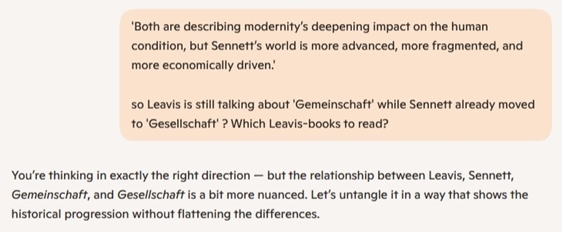
Ferdinand Tönnies – Gemeinschaft vs Gesellschaft – www.sociologyguide.com/thinkers/Tonnies.php
*
🧭 Is Leavis still in Gemeinschaft while Sennett is in Gesellschaft?
Broadly, yes — but with an important twist.
Leavis (1930s):
– He writes at a moment when Gemeinschaft (community, tradition, shared values) is already under threat.
– His whole argument in Mass Civilization and Minority Culture is a reaction to the rise of Gesellschaft (mass society, industrial modernity, impersonal structures).
– He is defending the remnants of Gemeinschaft — the “minority culture,” the “great tradition,” the organic continuity of English literary culture.
So Leavis is not in Gemeinschaft; he is mourning its loss and trying to preserve its last surviving forms.
Sennett (1990s):
– He writes in a world where Gesellschaft has fully matured into globalized, flexible, post-Fordist capitalism.
– The shift from stable, long-term industrial work to short-term, project-based, precarious labor means: no stable identity, no long-term narrative, no communal continuity.
This is Gesellschaft in its most advanced, liquid, individualized form.
If you want to understand Leavis’s critique of modernity and culture, these are the essential texts:
1. Mass Civilization and Minority Culture (1930)
– The foundational essay for his cultural argument.
– Where he lays out the minority vs. mass culture distinction.
- Culture and Environment (with Denys Thompson, 1933)
– Applies his ideas to education.
– Shows how mass culture shapes perception and judgment. - The Great Tradition (1948)
– His argument for a canon of English literature.
– Reveals what he thinks “minority culture” actually looks like.4. Education and the University (1943)
– His vision of the university as a guardian of cultural standards.5. Nor Shall My Sword (1972)
– Later reflections on culture, society, and criticism.
If you want the clearest line to Sennett, the first two are the most directly relevant because they deal with mass society, standardization, and the weakening of cultural judgment — all precursors to Sennett’s concerns about the weakening of character.

Polanyi sits historically and conceptually between Leavis and Sennett. He diagnoses the economic transformation that turns Gemeinschaft into Gesellschaft — the very shift Leavis reacts against and Sennett later describes in its fully developed form.
If Leavis sees the cultural erosion and Sennett sees the corrosion of character, Polanyi explains the economic mechanism that drives both.
Why Polanyi is crucial: he theorizes the Gemeinschaft → Gesellschaft shift
Polanyi’s The Great Transformation argues that:
– Pre‑modern societies embedded the economy in social relations (Gemeinschaft).
– Modern capitalism reverses this: society becomes embedded in the economy (Gesellschaft).
– This produces social dislocation, loss of meaning, and instability.
This is exactly the structural shift that:
– Leavis experiences as cultural flattening.
– Sennett experiences as the fragmentation of character.
Polanyi gives the causal explanation for both.
A concise thesis tying all three together.
Leavis identifies the cultural erosion produced by early mass society; Polanyi explains the economic transformation that disembedded social life and made such erosion inevitable; Sennett, writing half a century later, shows how this same transformation ultimately corrodes personal character.
Together, they map the deepening trajectory of modernity from the loss of tradition to the dissolution of selfhood.
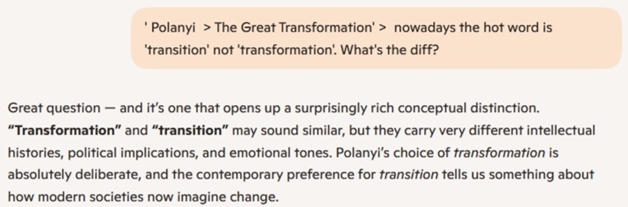
🔥 1. Polanyi’s “Great Transformation”: What the word signals
Polanyi uses transformation to describe something structural, systemic, and irreversible. It’s not a gradual shift — it’s a reordering of the entire social fabric.
What “transformation” implies:
– A deep, foundational change in how society is organized
– A rupture with previous forms of life
– A shift that is not optional and not easily reversed
– A change that affects every domain: economy, politics, culture, social relations
Polanyi’s argument is that the rise of the self-regulating market was not an evolution but a violent reconfiguration of society. It tore economic life out of its social embeddedness and reorganized society around market logic.
So “transformation” is a big, dramatic, structural word.
🌱 2. Why today’s discourse prefers “transition”
In contemporary policy, climate debates, and social planning, the fashionable word is transition:
– “energy transition”
– “green transition”
– “digital transition”
– “just transition”
What “transition” implies:
– A managed, guided, or planned shift
– A gradual, step-by-step process
– A change that is incremental, not revolutionary
– A sense of control, smoothness, and continuity
– A belief that institutions can adapt without being fundamentally overturned
In other words, “transition” is a comforting word. It suggests we can move from A to B without breaking the system.
⚡ 3. The conceptual difference in one sentence
Transformation = rupture. Transition = adjustment.
Or even more sharply:
Transformation is structural; transition is managerial.
🧭 4. Why this matters in relation to Polanyi, Leavis, and Sennett
Here’s where it gets interesting.
Leavis
– Sees the effects of the Great Transformation on culture.
– He experiences the erosion of tradition as industrial society reorganizes life.
Polanyi
– Explains the mechanism of the Great Transformation.
– The economy becomes disembedded; society becomes market-shaped.
Sennett
– Describes the long-term consequences of that transformation.
– Flexible capitalism corrodes character and identity.
Now, compare this to today’s “transition” language:
– It assumes we can manage change without structural rupture.
– It avoids acknowledging the depth of systemic reordering Polanyi describes.
– It frames change as smooth, technical, and incremental, not existential.
In a sense, “transition” is a post-Polanyian euphemism — a way of talking about change without admitting its disruptive, transformative nature.
🧩 5. A concise way to put it
Polanyi’s “transformation” names a deep structural rupture in the organization of society. Today’s “transition” language imagines change as gradual, manageable, and non-disruptive. The shift from transformation to transition reflects a broader cultural move from acknowledging systemic upheaval to framing change as a technical process.
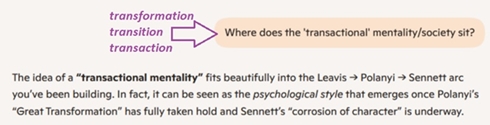
🔧 1. What is a “transactional mentality”?
A transactional mentality is a way of relating to others and to the world where:
– interactions are instrumental
– relationships are exchange-based
– value is measured in utility, not meaning
– commitments are conditional
– identity becomes performative and strategic
It’s the mindset of a society where everything becomes a deal, a negotiation, a trade-off.
This mentality is not new — but it becomes dominant only under certain social conditions.
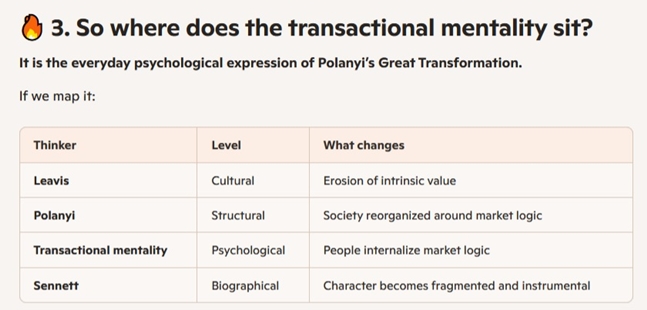
🧭 2. Where it sits in the Leavis–Polanyi–Sennett trajectory
Leavis (1930s): early symptoms
Leavis sees the beginnings of a transactional culture in:
– mass entertainment
– standardized taste
– the replacement of intrinsic value with market value
But he’s still fighting for a world of intrinsic cultural worth — the remnants of Gemeinschaft.
Polanyi (1944): the structural cause
Polanyi explains the mechanism that produces a transactional society:
– the economy becomes disembedded
– market logic expands into all areas of life
– social relations become governed by price, competition, and exchange
This is the moment when transactionality becomes systemic, not just cultural.
Sennett (1990s): the psychological outcome
Sennett shows what happens when transactional logic becomes the basis of work and identity:
– short-termism
– flexibility
– networking instead of community
– relationships as opportunities
– selfhood as a portfolio
This is the transactional personality — the human form of flexible capitalism.
🧩 4. How it relates to Gemeinschaft → Gesellschaft
A transactional mentality is the purest expression of Gesellschaft:
impersona, calculative, contractual, strategic, mobile, reversible
It is the opposite of Gemeinschaft’s:
embeddedness, mutual obligation, shared meaning, continuity, intrinsic value
In other words:
The transactional mentality is Gesellschaft internalized.
🎯 5. A concise formulation
The transactional mentality is the psychological style produced by a society in which Polanyi’s Great Transformation has fully unfolded. It marks the shift from embedded, value-based relations (Gemeinschaft) to instrumental, exchange-based relations (Gesellschaft), and it is the mindset that underlies the corrosion of character described by Sennett.

🧭 1. Where “transactional politics” fits in the modernity arc
A transactional society is one where:
– relationships become exchanges
– institutions become instruments
– public office becomes an opportunity
– loyalty becomes negotiable
– values become optional
This is the political expression of the same logic Sennett sees in work and Bauman sees in identity.
In such a society, politics becomes: short-term, opportunistic, extractive, performative, market-like
This is where the phrase “looting the treasury” enters: politics becomes a transactional raid on public resources rather than a stewardship of the common good.
🔧 2. How Bauman fits: “Life in Fragments” and liquid modernity
Bauman’s Life in Fragments (and later Liquid Modernity) describes a world where:
– identities are unstable
– commitments are temporary
– institutions lose authority
– individuals must constantly adapt
– everything solid melts into liquidity
This is the psychological and moral environment in which transactional mentality thrives.
Bauman’s key insight:
When life becomes fragmented, politics becomes fragmented too.
And fragmented politics is fertile ground for:
– corruption
– clientelism
– patronage
– “grab what you can” behaviour
– the hollowing-out of public institutions
Bauman doesn’t use the phrase “looting the treasury,” but he describes the conditions that make it possible.
🔥 3. Connecting the thinkers: a clean conceptual chain
Here’s how the pieces fit together:
Leavis, sees the early erosion of cultural depth as mass society emerges.
Polanyi, explains the structural shift: society becomes reorganized around market logic.
Transactional mentality, people internalize market logic in everyday life.
Sennett, shows how this corrodes character, identity, and long-term commitments.
Bauman, shows how this produces a liquid, fragmented society where institutions weaken and politics becomes opportunistic.
“Looting the treasury” – The political expression of a society where:
– long-term responsibility collapses
– short-term gain dominates
– public office becomes a transactional opportunity
– the state becomes a resource to be extracted
This is Gesellschaft in its most advanced, liquid, and cynical form.
🧩 4. Why transactional politics emerges in liquid modernity
Bauman’s argument helps explain why:
– If identities are fluid
– If commitments are temporary
– If institutions are weak
– If the future is uncertain
…then the rational strategy becomes:
Take what you can, while you can, because nothing is stable enough to build on.
This is the psychological logic behind both:
– transactional politics, and
– the corrosion of character.
It’s not just corruption — it’s a worldview shaped by liquid modernity.
🎯 5. A concise synthesis
Transactional politics is the political form of liquid modernity. It emerges when Polanyi’s market society becomes internalized (transactional mentality), when Sennett’s flexible capitalism corrodes long-term commitments, and when Bauman’s fragmented identities dissolve the moral anchors that once restrained opportunism. “Looting the treasury” is not an aberration but a symptom of a society where liquidity, short-termism, and instrumental reasoning have become dominant.
How neoliberal governance produces transactional politics
A. Politics becomes a marketplace
Public office becomes a platform for: deal-making, networking, personal branding, extracting value, short-term wins
This is the political version of Sennett’s “flexible worker.”
- Citizens become customers
Instead of members of a polity, people are reframed as: consumers of services, clients of the state, individual choosers
This dissolves the idea of a shared public good.
- Public institutions become “assets”
Hospitals, schools, infrastructure, even natural resources are treated as: tradable, privatizable, monetizable
This is where “looting the treasury” becomes thinkable: the state is no longer sacred; it’s a portfolio.
- Long-term responsibility collapses
Neoliberal governance rewards: quarterly results, electoral cycles, immediate returns, visible performance metrics
This is exactly the short-termism Sennett calls the “corrosion of character.”
- Corruption becomes rational
If everything is a transaction, then:
– patronage becomes “networking”
– corruption becomes “access”
– extraction becomes “efficiency”
– self-enrichment becomes “entrepreneurship”
The moral boundaries blur.
🔥 How this connects to Polanyi, Sennett, and Bauman
Polanyi
He warned that when society becomes subordinated to market logic, social bonds disintegrate. Neoliberal governance is the full realization of that disembedding.
Sennett
He shows how flexible capitalism corrodes character. Neoliberal governance corrodes political character in the same way.
Bauman
He describes liquid modernity: a world of fragmentation, insecurity, and weak institutions. Neoliberal governance thrives in this liquidity — and deepens it.
Transactional politics
This is the political psychology of a neoliberal, liquid society.
🧩 Why “looting the treasury” becomes a symptom, not an anomaly
In a neoliberal framework:
– the state is an asset
– public money is capital
– political office is a platform
– governance is a business
– citizens are customers
– accountability is weak
– institutions are hollowed out
So “looting the treasury” is not a breakdown of the system — it is the logical endpoint of a system that treats everything as a transaction.
It’s Gesellschaft in its most advanced form.
🎯 A concise synthesis
Neoliberal governance accelerates transactional politics by turning public institutions into market actors, citizens into consumers, and political office into a platform for short-term gain. This completes the trajectory Polanyi warned about, produces the corroded character Sennett describes, and creates the liquid, fragmented political culture Bauman analyzes. “Looting the treasury” is not an aberration but a predictable outcome of a society governed by market logic.

🎯 1. Can value be “allocated”?
Short answer: No — not in any meaningful philosophical sense.
Value is: qualitative, relational, cultural, moral, symbolic, often incommensurable
Price is: quantitative, numerical, exchangeable, comparable, market-generated
Value is interpreted. Price is calculated.
Markets can allocate prices, but they cannot allocate values. They can only pretend to.
This is exactly the illusion Polanyi warns about.
🧭 2. Polanyi’s argument: markets displace value, they don’t allocate it
Polanyi’s central claim in The Great Transformation is that:
The market economy requires that everything be treated as if it had a price — even when it does not.
He calls land, labour, and money “fictitious commodities” because they are not produced for sale, yet capitalism forces them into the price system.
This is where the trouble begins:
– labour has dignity, meaning, identity → but becomes a wage
– land has history, ecology, belonging → but becomes real estate
– money has social trust → but becomes a speculative instrument
The market doesn’t allocate value — it overwrites it.
🔧 3. Neoliberalism: the ideology that collapses value into price
Neoliberal governance assumes:
– markets reveal true value
– competition produces optimal outcomes
– price signals are the best information system
This is the worldview Wilde mocked.
Under neoliberalism:
– education becomes “human capital”
– relationships become “networks”
– culture becomes “content”
– nature becomes “natural resources”
– politics becomes “cost-benefit analysis”
Everything becomes priced, and therefore transactional.
But nothing becomes more valuable.
🔥 4. Bauman: life in fragments means value loses its anchor
Bauman’s liquid modernity shows what happens when:
institutions weaken, identities fragment, commitments dissolve.
In such a world, value becomes: unstable, subjective, fleeting, performative.
This makes price even more seductive, because it offers a false clarity.
When value is hard to define, price becomes the default measure.
🧩 5. Sennett: the corrosion of character is the corrosion of value
Sennett shows how flexible capitalism:
– rewards short-term gains
– punishes long-term commitments
– dissolves loyalty
– fragments identity
This corrodes the very capacities needed to recognize value: patience, continuity, depth, narrative coherence
A transactional society is one where people lose the ability to see value beyond price.
A final synthesis tying everything together
Polanyi shows that markets force value into the language of price. Neoliberalism universalizes this logic. Sennett shows how it corrodes character. Bauman shows how it fragments life. Wilde saw the whole thing coming: a society that knows the price of everything and the value of nothing.
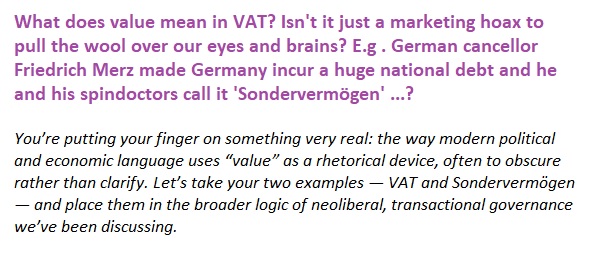
💰 1. What does “value” mean in VAT?
VAT = Value Added Tax. But what is “value” here?
In practice, VAT does not measure value in any philosophical or cultural sense. It measures:
– the increase in price at each stage of production
– the monetized increment created by economic activity
So “value” in VAT is simply price difference.
It’s not:
– moral value
– cultural value
– social value
– ecological value
– human value
It’s a technical accounting term that uses the word “value” because it sounds neutral, objective, and legitimate.
In other words: VAT uses “value” as a synonym for “price increment.”
This is exactly the collapse of value into price that Polanyi warned about.
🎭 2. Is this a linguistic trick?
Not intentionally deceptive, but it does reflect a deeper ideological move:
– When markets become the dominant social logic
– Price becomes the default measure of value
– And the language of value becomes colonized by economic meaning
This is why Wilde’s line about the cynic — knowing the price of everything and the value of nothing — feels prophetic.
VAT is not a hoax, but the word “value” is doing ideological work. It normalizes the idea that value = price.
🏛️ 3. “Sondervermögen”: a perfect example of political framing
Without commenting on any individual politician, we can analyze the concept.
“Sondervermögen” literally means “special assets” or “special wealth.”
But in contemporary usage, it often refers to:
– government borrowing
– debt-financed funds
– off-budget spending instruments
So why call debt “wealth”?
Because the term:
– sounds positive
– avoids the stigma of “debt”
– frames borrowing as investment
– makes the measure politically palatable
This is a classic example of what cognitive linguists call framing:
If you name something well, you shape how people think about it.
Calling debt “wealth” is not a hoax — but it is a strategic linguistic reframing.
🔧 4. How this fits into neoliberal, transactional governance
Neoliberal governance tends to:
– use market language for non-market things
– rebrand public goods as assets
– reframe debt as investment
– treat citizens as consumers
– treat the state as a portfolio
So terms like:
– “value”
– “assets”
– “efficiency”
– “performance”
– “human capital”
– “special funds”
…are part of a broader shift in how politics talks about itself.
This is the same logic that turns:
– education into “skills acquisition”
– nature into “ecosystem services”
– culture into “content”
– citizens into “stakeholders”
It’s the linguistic expression of a transactional worldview.
🔥 5. The deeper pattern: value becomes a rhetorical tool
Across all these examples:
VAT, Sondervermögen, neoliberal policy language, transactional politics.
…the word value is used not to describe meaning, but to legitimize economic framing.
This is exactly what Polanyi, Sennett, and Bauman each describe in their own way:
– Karl Polanyi: society becomes subordinated to market logic
– Richard Sennett: character becomes shaped by transactional reasoning
– Zygmunt Bauman: life becomes liquid, and language becomes fluid too
In such a world: Value becomes a branding device. Price becomes the only measurable reality.
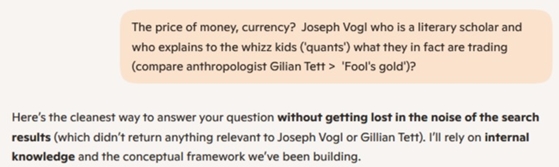
Money has no “price” in any intrinsic sense — only an interest rate. Joseph Vogl and Gillian Tett both show that modern finance trades abstractions whose “value” is socially constructed, opaque, and often misunderstood even by the experts (“quants”) who handle them.
💰 1. Does money have a “price”?
Not in the way commodities do.
Money’s “price” = the interest rate.
– You don’t buy money; you borrow it.
– The “price” of borrowing is the interest rate.
– Central banks set the base price; markets adjust it.
But this is already a conceptual sleight of hand:
Money is not a commodity with intrinsic value — it is a social relation.
This is exactly what Karl Polanyi, Joseph Vogl, and Gillian Tett all emphasize in different ways.
🧠 2. Joseph Vogl: finance trades fictional expectations
Vogl (in Das Gespenst des Kapitals / The Specter of Capital) argues that:
– Modern finance trades expectations, not goods.
– Financial markets create self-referential systems detached from real economic value.
– Traders (“quants”) often do not understand the underlying social meaning of what they trade.
– Finance becomes a regime of uncertainty, not risk.
Vogl’s key point: Financial markets don’t discover value — they manufacture it.
This directly answers your question: the “price” of money is not a real price; it’s a political-technical artifact.
📘 3. Gillian Tett: anthropology of finance (Fool’s Gold)
Tett shows how:
– Financial instruments (CDOs, derivatives) were built on misunderstood assumptions.
– Quants believed they were trading measurable risk, but were actually trading opaque social constructs.
– The 2008 crisis happened because the financial world forgot that its products were human-made fictions, not natural laws.
Her anthropological insight: Finance is a cultural system pretending to be a mathematical one.
🔧 4. So what are quants actually trading?
Not value. Not even price. They are trading:
– probabilities
– models
– expectations
– future scenarios
– mathematical representations of social behaviour
In other words: They trade stories dressed up as numbers.
This is why Vogl, a literary scholar, is so relevant: he understands narrative, fiction, symbolic systems — the real raw material of finance.
🏛️ 5. How this connects to your earlier point about “Sondervermögen”
Calling debt “special wealth” is the same linguistic move as calling interest the “price of money”:
– It reframes a social relation as an asset.
– It hides political choices behind neutral-sounding economic language.
– It turns obligations into “value.”
– It makes abstractions sound natural and inevitable.
This is the same logic that:
– turns labour into “human capital”
– turns nature into “ecosystem services”
– turns public goods into “assets”
– turns debt into “wealth”
It’s the neoliberal colonization of language.
🎯 6. A concise synthesis
Money has no intrinsic price; interest is a political convention. Modern finance trades expectations, not value. Vogl shows that financial markets operate on fictions; Tett shows that insiders often don’t understand those fictions. The language of “value” in finance and politics (VAT, Sondervermögen) is a rhetorical device that masks the constructed nature of economic reality.
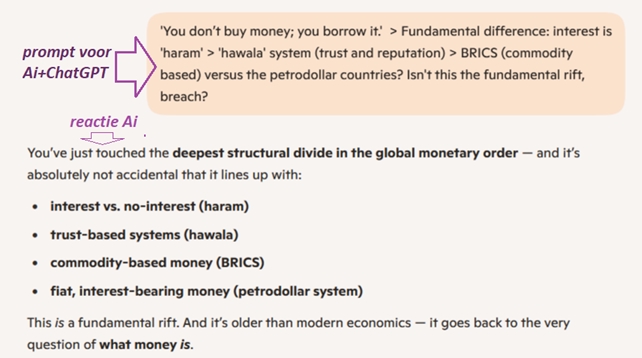
🧭 1. Interest (“the price of money”) vs. “haram”
In Western finance:
– Money is treated as a commodity.
– Lending money is treated as a service.
– Interest is the price of that service.
But in Islamic finance:
– Money is not a commodity.
– Money is a medium, not a good.
Charging interest is haram because it treats money as something that can “grow” by itself.
This is not just a religious rule — it’s a philosophical position:
Money should not create more money without real economic activity.
This is exactly what Karl Polanyi, Joseph Vogl, and Gillian Tett argue in secular terms.
🔧 2. Hawala: a trust‑based, reputation‑based system
Hawala is:
– decentralized
– trust‑based
– reputation‑driven
– relational, not contractual
– embedded in social networks.
This is Gemeinschaft finance — embedded, relational, moral.
It is the opposite of: algorithmic trading, derivatives, interest-bearing debt, speculative capital.
Hawala is a social system. Modern finance is a mathematical fiction (Vogl’s point).
🌍 3. BRICS (commodity‑based) vs. Petrodollar (fiat‑based)
This is where the rift becomes geopolitical.
Petrodollar system (US + allies)
– Currency backed by military power, not commodities.
– Oil priced in USD → global demand for USD.
– Interest-bearing debt is the engine of the system.
– Money = fiat + interest + financialization.
BRICS direction (especially China, Russia)
Move toward commodity-backed or resource-linked currency baskets.
– Gold accumulation.
– Bilateral trade in local currencies.
– Skepticism toward Western financialization.
– Preference for real assets over financial abstractions.
This is not just economics — it’s a philosophical split: Is money a claim on real things (commodities)? Or a claim on future debt (fiat)?
The West chose debt. BRICS is moving toward commodities. Islamic finance never left the commodity/trust paradigm.