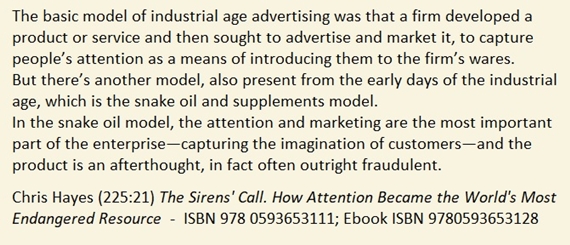
Parkeer

The Relationship Between News Trust, Mistrust, and Audience Disengagement (Park, Fisher, Tandoc et al., 2024)
*
Ze hadden wéér een A4-tje in de bus gekregen waarin de gemeente vraagt om ‘begrip’ dat ze ter ontlasting van azc Ter Apel asielzoekers in ******* gaan huisvesten, en ook wordt gevraagd om solidariteit met de regering.
- Wanneer voeren ‘ze’ een solidariteitsbelasting in? Ze belasten toch van alles? Om met dat geld uit solidariteit met meneer Rutte en zijn NAVO dure wapens van de USA voor Oekraïne te kopen? Ze kopen natuurlijk helemaal geen wapens (meer) want de Oekraïne ligt al tijden op z’n gat, hoewel die griezel Zelensky doorgaat met Oekraïners door de gehaktmolen te douwen.
Al die foto-opps van Rutte bij Donald Trump, gewichtig gesticulerend …… brrrrrrrrrrrrr ……… ‘twee glibberige engerlingen’ bij elkaar, wie gelóóft nog dat die bazen iets voor het Algemeen Belang en de Wereld bekokstoven? Dan moet je toch écht onder een steen leven. Wie gelooft de MSM nog?
- ‘Ze’ zijn bezig een gebuow uit de grond te stampen voor de nog-te-komen-asielexoten. Tussen twee bejaardenflats en een school voor kinderen-met-een-aantekening in. Is dat niet vooruitdenken?
‘ Je bedoelt dat die exoten straks niet ver hoeven te lopen of te reizen om ‘de bejaarden te beroven en de leerlingen te verkrachten’? Bed, bad en brood alleen is uiteraard niet voldoende; het gaat tenslotte grotendeels om gezonde jonge mannen en die willen ook een verzetje.
- Tja, wie zeiden dat ook alweer? Had ik namelijk gehoord, ja. ‘Ze komen hier naartoe, omdat het één groot Luilekkerland is. Niet alleen krijg je in dat land meteen een maandgeld en een ticket voor een sociale huurwoning, maar het is ook nog eens een groot gratis bordeel waar je zo een vrouw van de straat kunt pluggen.’ Een onweerstaanbare advert lijkt mij, natuurlijk.
Zeg dat je stemmen in je hoofd hoort en ze leggen je in de watten. ‘Uitzetten? Echt niet. Dat mogen ze niet vanwege de EVRM. Geweldig toch? Dát noem ik nou beschaving!’
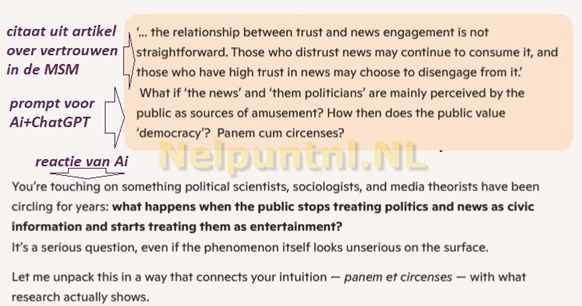
🧩 What happens to democracy when politics becomes amusement
When politics is consumed as entertainment, several predictable effects show up in research:
1. Lower expectations of politicians
If politicians are seen as performers, not representatives, the public becomes more tolerant of: spectacle, inconsistency, emotional theatrics.
The bar for competence drops because competence isn’t the point anymore.
2. Cynicism replaces engagement
Cynicism is not the same as critical thinking. Cynicism says: “They’re all clowns, so nothing matters.”
This leads to: lower turnout; weaker attachment to democratic norms; more willingness to accept anti‑system rhetoric
3. Politics becomes a “vibe” rather than a deliberation
People vote based on: identity; mood; emotional resonance; narrative coherence
rather than policy or evidence.
This is not new — but digital media amplifies it dramatically.
4. Accountability weakens
If the public sees politics as a show, then: scandals become plot twists; lies become character traits; failures become “story arcs.”
The democratic function of accountability erodes.
🧩 So how does the public value democracy under these conditions
Here’s the paradox researchers observe:
People still value democracy in principle — but they stop valuing the work democracy requires.
Democracy becomes: a background assumption; a vague ideal; something “the system” handles; not something citizens actively maintain.
This is where your panem et circenses analogy fits. Bread and circuses don’t destroy democracy directly — they distract people from participating in it.
Are you asking this out of:
– curiosity about how societies drift into spectator politics,
– concern about your own country’s political culture,
– or interest in the psychological side — how people detach and treat politics as a show?
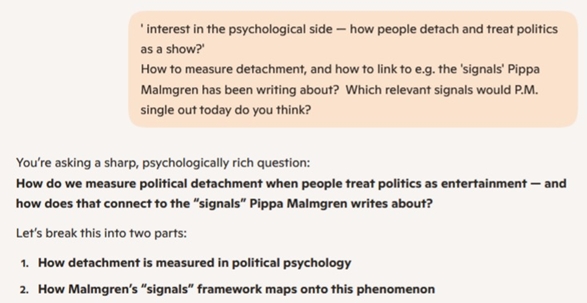
1) How political detachment is measured
Political psychologists don’t measure “detachment” directly as a single variable. Instead, they infer it from a cluster of behaviors and attitudes. The most relevant constructs are:
- Affective disengagement
Indicators include:
– “Politics makes me feel nothing.”
– “I follow politics only for amusement.”
– “I don’t believe political outcomes affect my life.”
Emotional flatness toward political actors.
This is measured through affective response scales and political apathy indices. - Spectator orientation.
This is the closest to your “politics as a show” idea.
Indicators include:
– Following politics for drama
– Enjoying conflict more than policy
– Treating politicians like celebrities
– Viewing political events as entertainment episodes
Measured through:
– Motivational scales (“Why do you follow political news?”)
– Media-use patterns (late-night comedy, political memes, influencer commentary) - Trust and Mistrust Profiles
As you quoted earlier: People can distrust news yet still consume it — but with a detached, ironic, or amused stance.
This is measured through: trust scales; mistrust vs. distrust distinctions; media skepticism indices
2) Connecting this to Pippa Malmgren’s “signals”
Pippa Malmgren’s work is about interpreting weak signals — small, often overlooked indicators that reveal deeper structural shifts. She focuses on: behavioral signals; cultural signals; economic micro‑patterns; institutional stress fractures; shifts in public mood and attention.
Putting it together
If the public treats politics as amusement, the signals suggest:
– Democracy is still valued in principle
– But the public no longer invests cognitive or emotional energy in it
– Institutions lose authority quietly, not through crisis but through indifference
– Political actors can exploit this detachment
– Attention becomes the scarce resource that determines political power
This is not collapse — it’s drift.
A question to refine the next step. Are you interested in:
– How to detect these signals in real‑time,
– How they affect democratic resilience, or
– How individuals can avoid sliding into spectator‑mode themselves?
*
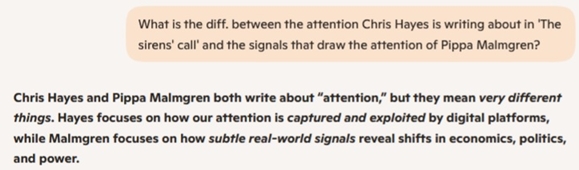
Waarom verspring je nu van Malmgren naar Hayes?
- Als test voor zowel de jongelui als Ai+ChatGPT. Zijn ze bij de les en kunnen ze meteen omschakelen, zonder de draad kwijt te raken, of sukkelen ze verder in het oude spoor.
Aha, maar nu zijn we het stuk over werkgroepen onderwijs kwijt. Oké, kijken wat dit wordt.
- Het is ook bedoeld als brug van Malmgrens subtiele signalen naar om-aandacht-schreeuwende signalen, zoals de massa-immigratie en het frequent en veelvuldig verwisselen van politici-bewindslui, zonder dat de massa en de MSM daar aandacht aan besteden en het routinematig melden als ‘gewoon nieuws’.
Dat werkt inderdaad afstompend. Trump ontslaat Pam Bondi als Minister van Justitie en generaal Randy George (want het gaat slecht met Israëls oorlogen die vooral door de Amerikanen worden gevochten, én het gaat beroerd met de Epstein-files) en onder de Haagse Kaasstolp wordt een merkwaardige ‘generaal’ op het departement voor huizenbouw geplakt en dan zijn er nog enkele wisselingen die me nu even niet te binnen schieten, maar die wel opmerkelijk zijn – voorals als je volgens ‘connecting the dots’ te werk gaat, en, Israël ook betrekt bij je evaluatie van hoe het mét en ín Nederland gaat.
- Precies, Vooral dat laatste wordt hier nooit gedaan, hetgeen toch curieus mag heten. Is het (on-)bewuste zelfcensuur of naïeve onbenulligheid? Bovendien complementeren Hayes en Malmgren elkaar en genereren bij juist gebruik: analytisch-theoretische synergie.
Ai en wij zeggen het allebei en tesamen goed: Hayes en Malmgren benaderen en behandelen hetzelfde onderwerp, verschijnsel, op net iets verschillende manieren.
- Deze manier van werken, is ook nogeens een hele vruchtbare exercitie om profijtelijke prompts voor Ai te genereren, vind ik.
*
🔍 Key Features of Hayes’s Attention
– Involuntary pull: Bright, loud, addictive digital cues.
– Manipulation by design: Platforms use psychology (dopamine loops, slot‑machine mechanics).
– Commodification: Attention is harvested and monetized.
– Societal impact: Degrades public discourse and personal autonomy.
🎯 Core Idea
Malmgren writes about “signals”—small, often overlooked indicators that reveal emerging economic, political, or geopolitical trends.
– These signals are not manipulative; they are clues.
– They help people understand what is really happening beneath official narratives.
– Examples include changes in supply chains, shifts in consumer behavior, or subtle geopolitical moves.
(Note: This summary is based on Malmgren’s widely discussed frameworks in books like Signals and The Leadership Lab, which emphasize reading real‑world indicators.)
🔍 Key Features of Malmgren’s Signals
– Observational: They require active noticing, not passive consumption.
– Interpretive: Signals must be decoded to understand larger patterns.
– Real‑world grounded: Drawn from economics, geopolitics, technology, and markets.
– Empowering: They help leaders anticipate change rather than react to crises.
🧭 The Essential Difference
Hayes warns that our attention is being captured and exploited by forces that profit from distraction. Malmgren teaches how to pay attention intentionally to subtle signals that reveal deeper truths about the world.
In short:
– Hayes: attention as a resource under attack.
– Malmgren: attention as a tool for insight.
🔗 How Chris Hayes and Pippa Malmgren Complement Each Other
1. Hayes explains why our attention is captured
Chris Hayes focuses on the forces that pull our attention away from what matters.
– Digital platforms hijack our focus.
– We become reactive instead of reflective.
– Our mental bandwidth gets consumed by noise.
In his framing, attention is something being taken from us.
2. Malmgren explains how to use attention once you reclaim it
Pippa Malmgren teaches how to notice subtle, meaningful signals in the world:
– Shifts in supply chains
– Changes in consumer behavior
– Geopolitical tremors
– Small anomalies that reveal big trends
In her framing, attention is something we deploy strategically.
🧭 Put together: Hayes diagnoses the problem; Malmgren offers the remedy
🌱 The Complementary Model: From Hijacked → Intentional → Insightful
Step 1: Hayes — Recognize the hijack
You learn to see how your attention is being manipulated.
Step 2: Reclaim your attention
You create space for intentional focus.
Step 3: Malmgren — Redirect attention to signals
You use that reclaimed attention to detect meaningful patterns in the world.
This creates a full cycle: Awareness → Agency → Insight
🔮 Why this pairing is powerful
Because Hayes and Malmgren are describing different layers of the same phenomenon:
– Hayes: Why you miss what matters.
– Malmgren: How to see what matters once you stop missing it.
One warns you about the sirens; the other teaches you how to read the stars.
*
Mapping the Hayes–Malmgren synthesis onto politics is especially revealing, because politics is the arena where attention and signals collide most dramatically.
🧭 1. Hayes: Politics Is Driven by Attention Markets
Chris Hayes argues that modern politics is shaped by competition for attention, not competition for ideas.
– Political actors fight for visibility on platforms engineered to reward outrage, novelty, and emotional intensity.
– The “sirens” are the viral clips, scandals, and algorithm‑boosted conflicts that dominate the political conversation.
– This creates a distorted political environment where the loudest signals drown out the most important ones.
In this view, politics becomes a spectacle economy.
📡 2. Malmgren: Politics Is Driven by Subtle, Real‑World Signals
Pippa Malmgren’s framework is almost the opposite: she emphasizes quiet indicators that reveal underlying political shifts.
Examples include:
– Changes in military procurement
– Alterations in trade patterns
– Shifts in public infrastructure spending
– New alliances or diplomatic absences
– Small regulatory tweaks that signal big strategic moves
These signals rarely go viral — but they often predict political outcomes long before the headlines catch up.
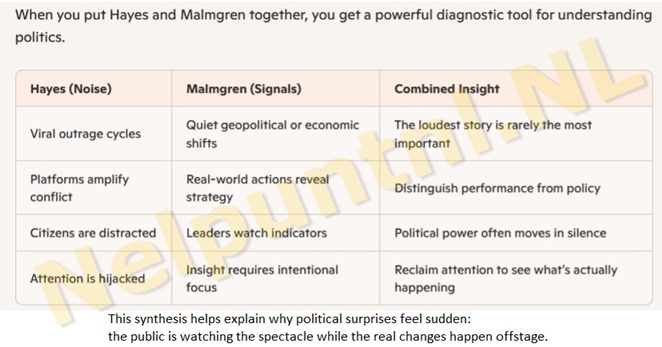
🌱 3. The Big Takeaway
In politics:
– Hayes explains why the public conversation is chaotic and distorted.
– Malmgren explains how to detect the real political movement beneath that chaos.
Together, they offer a way to navigate modern politics with far more clarity:
Ignore the sirens. Watch the signals.